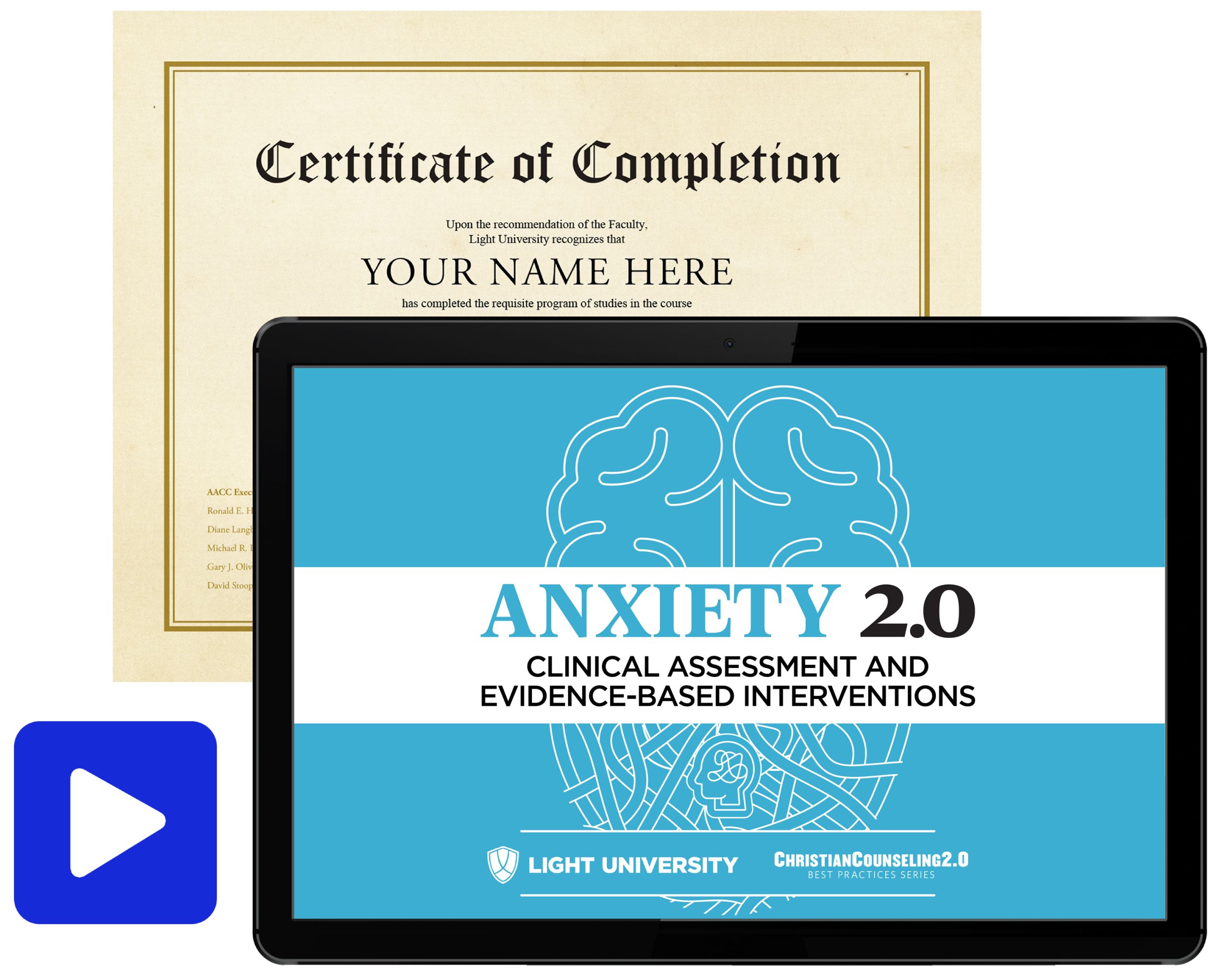
Anxiety 2.0: Clinical Assessment and Evidence-Based Interventions
$69.00
-
3 credit hours
Continuing Education Accreditations applicable to this course
NBCC, IBCC, Florida Board of Clinical Social Work, Marriage and Family Therapy and Mental Health Counseling
Intended Audience: Mental and Medical Health Professionals, Mental Health Coaches
| Course Topics | Anxiety, Professional Skills |
|---|---|
| Professions | Biblical Counselor, Mental Health Coach, Mental Health Professional, Pastor / Ministry Leader |
| Approved Boards | IBCC, NBCC |
| Number of Credits | 3 CE Credits |
| Course Length | 3 Hours |
Course Summary
Anxiety and prolonged stress are increasingly prevalent, impairing functioning and diminishing quality of life for millions of individuals across the lifespan. Anxiety 2.0: Clinical Assessment and Evidence-Based Interventions equips licensed mental health professionals with a comprehensive framework for accurate diagnosis and effective treatment. The course begins with clinical conceptualization, examining the multifactorial etiology of anxiety and clarifying DSM-5-TR distinctions to strengthen differential diagnosis and case formulation. Participants then examine the two primary neural pathways implicated in anxiety generation. Bottom-up, amygdala-driven processes are addressed through autonomic nervous system regulation, somatic interventions, graded exposure, and lifestyle strategies designed to reduce conditioned fear responses and physiological hyperarousal. Top-down, cortex-based processes are treated through cognitive behavioral therapy, identification of maladaptive schemas and cognitive distortions, systematic cognitive restructuring, and spiritually integrated contemplative practices that support cognitive renewal and emotional regulation. Emphasis is placed on clinical discernment regarding when each intervention pathway is indicated, equipping clinicians to deliver neurologically informed and spiritually integrated care.
Learning Objectives
Participants will…
- Differentiate anxiety disorders using DSM-5-TR criteria and develop case formulations that reflect biological, psychological, environmental, and spiritual contributors.
- Implement bottom-up interventions that regulate autonomic arousal, retrain amygdala-based fear responses, and apply exposure principles to reduce avoidance and conditioned anxiety.
- Apply top-down cognitive and spiritually integrated interventions, including cognitive restructuring and schema modification, to address maladaptive thought patterns and chronic worry.
Lesson Titles
ANXT 101: Clinical Conceptualization and Assessment of Anxiety
– Linda S. Mintle, Ph.D.
ANXT 102: Evidence-Based Treatments: Amygdala-based and Lifestyle Interventions
– Linda S. Mintle, Ph.D.
ANXT 103: Evidenced Based Treatments: Cortex-based and Spiritual Treatments
– Linda S. Mintle, Ph.D.
Continuing Education Approval Statements
 American Association of Christian Counselors has been approved by NBCC as an Approved Continuing Education Provider, ACEP No. 7543. Programs that do not qualify for NBCC credit are clearly identified. American Association of Christian Counselors is solely responsible for all aspects of the programs.
The American Association of Christian Counselors (AACC) offers some psychologists, therapists, counselors, social workers and play therapists Continuing Education (CE) credit due for good standing with certain states and a limited number of professional organizations. It remains the responsibility of each participant to be aware of state licensure and CE requirements.
Participants should check their state and/or local regulations regarding required continuing education hours. For more information Light University Continuing Education programs, please visit: https://lightuniversity.com/continuing-education-statements/
References
Aggarwal, S., Wright, J., Morgan, A., Patton, G., & Reavley, N. (2023). Religiosity and spirituality in the prevention and management of depression and anxiety in young people: A systematic review and meta-analysis. BMC Psychiatry, 23, 729. https://doi.org/10.1186/s12888-023-05091-2
American Psychiatric Association. (2022). Diagnostic and statistical manual of mental disorders (5th ed., text rev.; DSM-5-TR). American Psychiatric Association.
Andreasen, N. C., & Black, D. W. (2019). Introductory textbook of psychiatry (7th ed.). American Psychiatric Association.
Kozlowska, K., Scher, S., & Helgeland, H. (2020). Treatment interventions I: Working with the body. In Functional somatic symptoms in children and adolescents (pp. 245–268). Palgrave Macmillan. https://doi.org/10.1007/978-3-030-46184-3_14
LeDuke, D. O., Borio, M., Miranda, R., & Tye, K. M. (2023). Anxiety and depression: A top-down, bottom-up model of circuit function. Annals of the New York Academy of Sciences, 1525(1), 70–87. https://doi.org/10.1111/nyas.1499
Muhammad Khir, S., Wan Mohd Yunus, W. M. A., Mahmud, N., Wang, R., Panatik, S. A., Mohd Sukor, M. S., & Nordin, N. A. (2024). Efficacy of progressive muscle relaxation in adults for stress, anxiety, and depression: A systematic review. Psychology Research and Behavior Management, 17, 345–365. https://doi.org/10.2147/PRBM.S437277
Noordsy, D. L., Abbott-Frey, A., & Chawla, V. (2024, February 23). Special report: Lifestyle psychiatry emphasizes behaviors supporting mental health. Psychiatric News. https://doi.org/10.1176/appi.pn.2024.03.3.19
Papola, D. (2024). Psychotherapies for generalized anxiety disorder in adults: A systematic review and network meta-analysis of randomized clinical trials. JAMA Psychiatry, 81(3), 320. https://doi.org/10.1001/jamapsychiatry.2023.5364
Roll, S. C., Hardison, M. E., Vigen, C., & Black, D. S. (2020). Mindful body scans and sonographic biofeedback as preparatory activities to address patient psychological states in hand therapy: A pilot study. Hand Therapy, 25(3), 98–106. https://doi.org/10.1177/1758998320930752
Wang, Y., Vlemincx, E., Vantieghem, I., Dhar, M., Dong, D., & Vandekerckhove, M. (2022). Bottom-up and cognitive top-down emotion regulation: Experiential emotion regulation and cognitive reappraisal on stress relief and follow-up sleep physiology. International Journal of Environmental Research and Public Health, 19(13), 7621. https://doi.org/10.3390/ijerph19137621
The prevalence of anxiety in adult endocrinology outpatients: A systematic review and meta-analysis. (2023). Journal of Affective Disorders. https://pubmed.ncbi.nlm.nih.gov/37776733/
Additional information
| Course Topics | Anxiety, Professional Skills |
|---|---|
| Professions | Biblical Counselor, Mental Health Coach, Mental Health Professional, Pastor / Ministry Leader |
| Approved Boards | IBCC, NBCC |
| Number of Credits | 3 CE Credits |
| Course Length | 3 Hours |