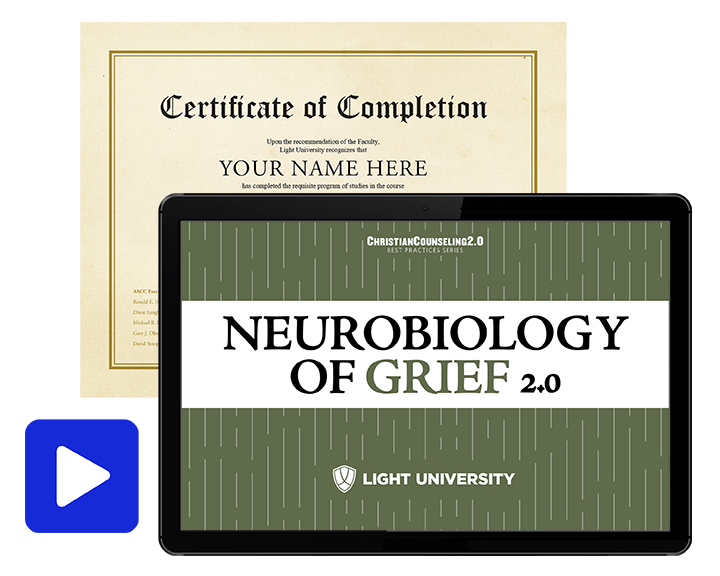
Neurobiology of Grief 2.0
$69.00
-
3 credit hours
Continuing Education Accreditations applicable to this course
NBCC, IBCC, Florida Board of Clinical Social Work, Marriage and Family Therapy and Mental Health Counseling
Intended Audience: Mental and Medical Health Professionals, Mental Health Coaches
About This Course
Neurobiology of Grief 2.0 examines how grief impacts the brain, body, and spirit. Participants learn how attachment bonds are formed in the brain and why separation creates stress responses, yearning, and searching. The course explains how grief is a normal human process, why most people show resilience, and what happens when grief becomes prolonged or derailed. Presenters describe different grieving styles, including head focused, heart focused, and blended patterns, and how these influence coping. Practical applications include rituals, memorials, and continuing bonds that help the brain adapt while honoring the loved one. The role of faith is emphasized as an important source of comfort and hope, especially the Christian belief in reunion and God’s presence in suffering. Participants are encouraged to companion grieving individuals with sensitivity, listening, and care. This training equips helpers with practical, neurobiology-informed strategies that support healthy adjustment after loss
Learning Objectives
Participants will…
- Explain how the brain encodes attachment bonds and why separation creates strong grief responses.
- Recognize the differences between common grief patterns, prolonged grief, and factors that may derail the process.
- Apply practical strategies such as companioning, rituals, and continuing bonds that support healthy grieving in those they serve.
Lesson Titles
NBGR 101: The Grieving Brain
Jennifer Ellers, M.A., and Kevin Ellers, D.Min.
This lesson introduces the neurobiology of grief and explains how the brain encodes attachment bonds. When a loved one is lost, the brain continues to anticipate reunion, releasing stress hormones and creating yearning and searching behaviors. Participants explore how grief impacts the whole person, including body, mind, and spirit, and how Christian faith offers hope and comfort in the midst of loss.
NBGR 102: The Grieving Process
Jennifer Ellers, M.A., and Kevin Ellers, D.Min.
This lesson examines grief as a normal human response and highlights why most individuals eventually show resilience. It also describes situations where grief may be prolonged or become derailed, such as when prior challenges or traumatic losses are present. Different grieving styles are presented, including head focused, heart focused, and blended patterns. Participants also consider how culture and faith influence the grieving process.
NBGR 103: Neurobiology Informed Practical Tools for Grief Support
Jennifer Ellers, M.A., and Kevin Ellers, D.Min.
This lesson provides practical tools for supporting those who are grieving. Participants learn the importance of companioning, rituals, memorials, and continuing bonds that help the brain and heart adapt after loss. The role of relational support, faith, and presence are emphasized, along with what is not helpful, such as rushing or prescribing a grieving process. Helpers are encouraged to listen, validate, and walk with individuals in ways that support healthy adjustment.
Course Presenter
Jennifer Ellers, M.A., and Kevin Ellers, D.MIn.
Continuing Education Approval Statements
 American Association of Christian Counselors has been approved by NBCC as an Approved Continuing Education Provider, ACEP No. 7543. Programs that do not qualify for NBCC credit are clearly identified. American Association of Christian Counselors is solely responsible for all aspects of the programs.
 The American Association of Christian Counselors (AACC) is an Approved Continuing Education CE provider by the International Board of Christian Care (IBCC). American Association of Christian Counselors is solely responsible for all aspects of the programs.
The American Association of Christian Counselors (AACC) offers some psychologists, therapists, counselors, social workers and play therapists Continuing Education (CE) credit due for good standing with certain states and a limited number of professional organizations. It remains the responsibility of each participant to be aware of state licensure and CE requirements.
Participants should check their state and/or local regulations regarding required continuing education hours. For more information Light University Continuing Education programs, please visit: https://lightuniversity.com/continuing-education-statements/