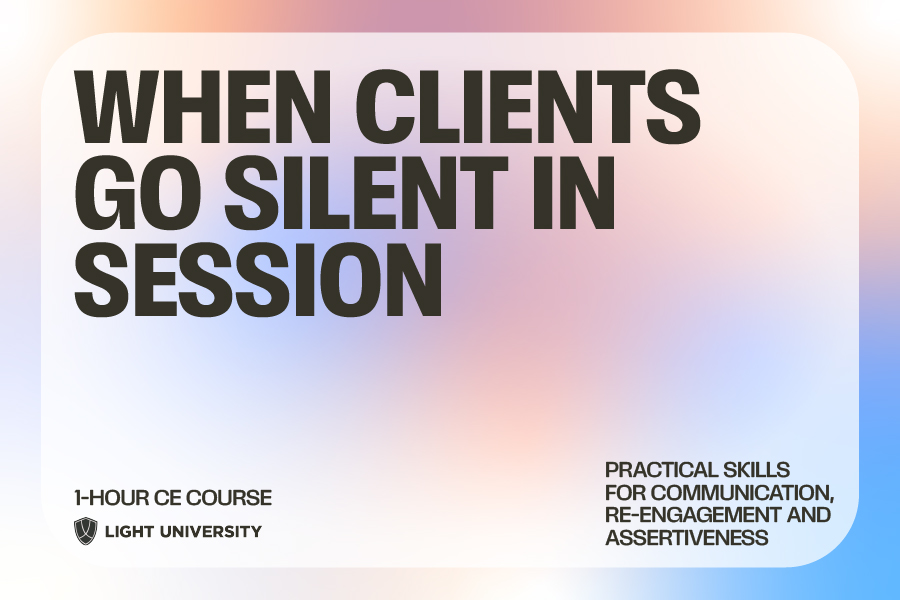
When Clients Go Silent in Session
$17.00
-
1 credit hour
Continuing Education Accreditations applicable to this course
NBCC, IBCC, Florida Board of Clinical Social Work, Marriage and Family Therapy and Mental Health Counseling
Intended Audience: Mental and Medical Health Professionals, Mental Health Coaches
About This Course
When a client goes quiet, it is rarely “nothing.” Silence can function as communication that signals overwhelm, threat sensitivity, shame, conflict avoidance, a pacing mismatch, or a moment of rupture in the therapeutic relationship. Often, these moments are paired with activation or dysregulation that limits access to language and flexible problem-solving. Because these presentations are so common and clinically significant, many clinicians find themselves addressing shutdown, withdrawal, or escalation without ever being directly trained in what to do next. This course equips clinicians with practical, evidence-informed skills for restoring communication in session without increasing pressure. Participants will learn how to interpret silence accurately, respond to activation with simple regulation strategies that reestablish felt safety, re-engage clients with language that preserves autonomy, and strengthen assertiveness skills that support clearer needs, requests, and boundaries in everyday relationships. Participants will also learn how to help clients identify and develop awareness of their communication patterns so they can understand what drives their silence under stress, anticipate predictable breakdowns, and practice strategies for staying engaged and communicating clearly.
Learning Objectives
Participants will...
- Differentiate common clinical functions of silence in session (for example processing, overwhelm, protection, shame, protest) and select an appropriate initial intervention, including first-line regulation strategies when activation is present.
- Demonstrate two low-pressure re-engagement strategies that restore communication while preserving client autonomy and therapeutic momentum.
- Support clients in identifying and developing awareness of their communication patterns and applying assertiveness skills to communicate needs, requests, and boundaries with greater clarity.
Course Presenter
Jason VanRuler, M.A.
Continuing Education Approval Statements
 American Association of Christian Counselors has been approved by NBCC as an Approved Continuing Education Provider, ACEP No. 7543. Programs that do not qualify for NBCC credit are clearly identified. American Association of Christian Counselors is solely responsible for all aspects of the programs.
 The American Association of Christian Counselors (AACC) is an Approved Continuing Education CE provider by the International Board of Christian Care (IBCC). American Association of Christian Counselors is solely responsible for all aspects of the programs.
The American Association of Christian Counselors (AACC) offers some psychologists, therapists, counselors, social workers and play therapists Continuing Education (CE) credit due for good standing with certain states and a limited number of professional organizations. It remains the responsibility of each participant to be aware of state licensure and CE requirements.
Participants should check their state and/or local regulationsregarding required continuing education hours. For more information Light University Continuing Education programs, please visit: https://lightuniversity.com/continuing-education-statements/