
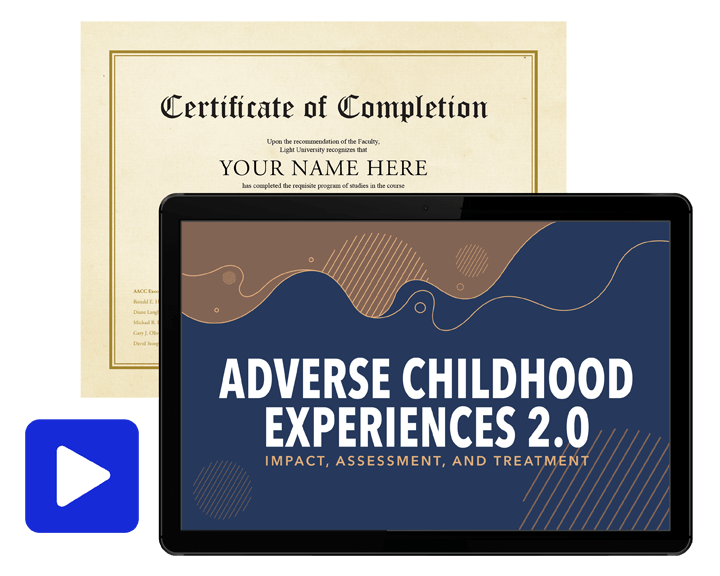
Adverse Childhood Experiences 2.0
Original price was: $149.00.$69.00Current price is: $69.00.
-
4 credit hours
Continuing Education Accreditations applicable to this course
NBCC, IBCC, Florida Board of Clinical Social Work, Marriage and Family Therapy and Mental Health Counseling
Intended Audience: Mental and Medical Health Professionals, Mental Health Coaches
About This Course
This course, designed for licensed mental health professionals, will look at trauma through the lens of Adverse Childhood Experiences (ACEs), which is an assessment and study that has produced a great wealth of knowledge about how trauma is often experienced in childhood and how it can manifest in adulthood. The Kaiser/CDC study will be described, and its results will be examined. The ACEs questionnaire will be introduced, and how it can be used to assess for childhood history of ACEs. Furthermore, participants will learn how to assess for dissociative symptoms to identify possible ACEs for which survivors have amnesia and proper referral sources if needed. The three-phase treatment model for complex trauma will be discussed as a valuable way to help those who have experienced ACEs. The importance of the spiritual and faith components of a person’s healing will also be discussed with careful descriptions for prevention, such as developing trauma-informed churches or faith-based organizations and working towards building family resilience.
Learning Objectives
Participants will...
- Describe the results of the ACE study and how childhood trauma can manifest in adulthood.
- Analyze and learn to administer the ACEs questionnaire.
- Assess for possible ACEs by identifying dissociative symptoms.
- Outline treatment options for individuals with a history of ACEs.
- Develop trauma-informed churches and other faith-based organizations and build family resilience as a means of prevention.
Course Lessons and Descriptions
ACE 101: Adverse Childhood Experiences: Impact, Assessment, and Treatment
Heather Davediuk Gingrich, Ph.D.
The ACEs study has been extremely important in that the findings have provided powerful scientific evidence for what trauma-informed mental health professionals have known anecdotally for decades, that is, that a childhood history of trauma has long-lasting impacts throughout the lifespan. This first module addresses the ACEs study and its findings, focusing on how faith-based mental health professionals with willing Christian clients can help break the multi-generational cycle of ACEs by helping to develop trauma-informed churches and help families work towards developing resilience.
ACE 102: Assessing for ACEs/Complex PTSD
Heather Davediuk Gingrich, Ph.D.
In part 2 of the course, the focus is on direct and indirect assessment of ACEs. Administering the ACEs questionnaire is discussed as a means of directly assessing ACEs. The Dissociative Experiences Scale is introduced as a screening tool for dissociative symptoms and is described as a way of alerting the licensed mental health professional to a possible history of ACEs for which their client may be unaware. The BASK Model of Dissociation is also described as a lens through which dissociative symptoms and, indirectly, ACEs can be identified.
ACE 103: Treatment Phase I
Heather Davediuk Gingrich, Ph.D.
In part 3, the phased treatment model for complex trauma is introduced as a possible treatment approach for clients with a history of ACEs. Phase I work, where the focus is on safety and symptom stabilization, is then explained, including how it can help immensely with the survivor’s ability to regulate emotion and help them function better day-to-day. Grounding techniques that can be used with any client are discussed, as well as how to use such clients’ dissociative abilities to help contain symptoms, at least temporarily.
ACE 104: Treatment Phases II and III and Addressing Spirituality
Heather Davediuk Gingrich, Ph.D.
The initial discussion in Part 4 is related to assessing when a client is ready for the trauma processing at the core of Phase II treatment, after which guidelines on how to safely and effectively guide a client through processing a particular memory are examined. For example, how to not be suggestive or ask leading questions when processing a particular memory are addressed, as are how to integrate the BASK components of memory (i.e., integration of experience) and how to pace trauma processing sessions carefully. The task of integrating the level of the client’s self and identity through working through intense emotions is then examined. Phase III work is also addressed, which involves consolidating changes and considering new avenues potentially open to survivors now that they have experienced so much healing. Finally, how and when to address spiritual and religious issues are considered.
Continuing Education Approval Statements
 American Association of Christian Counselors has been approved by NBCC as an Approved Continuing Education Provider, ACEP No. 7543. Programs that do not qualify for NBCC credit are clearly identified. American Association of Christian Counselors is solely responsible for all aspects of the programs.
 The American Association of Christian Counselors (AACC) is an Approved Continuing Education CE provider by the International Board of Christian Care (IBCC). American Association of Christian Counselors is solely responsible for all aspects of the programs.
The American Association of Christian Counselors (AACC) offers some psychologists, therapists, counselors, social workers and play therapists Continuing Education (CE) credit due for good standing with certain states and a limited number of professional organizations. It remains the responsibility of each participant to be aware of state licensure and CE requirements.
Participants should check their state and/or local regulations regarding required continuing education hours. For more information Light University Continuing Education programs, please visit: https://lightuniversity.com/continuing-education-statements/
Date Created: August 30th, 2024
Productos relacionados
-
¡Oferta!

Money and Financial Management 2.0: What You Need to Know
Original price was: $149.00.$69.00Current price is: $69.00.-
-
¡Oferta!

Racial Reconciliation and Healing 2.0
Original price was: $149.00.$69.00Current price is: $69.00.-
-
¡Oferta!
Crisis Response 2.0
Original price was: $149.00.$69.00Current price is: $69.00.-
-
¡Oferta!

Attachment and Communication in Marriage 2.0
Original price was: $149.00.$69.00Current price is: $69.00.-
