
ADHD Specialist Certificate Program
$99 per path · Ends November 30
Day(s)
:
Hour(s)
:
Minute(s)
:
Second(s)
Become an ADHD Specialist
Two Specialized Training Paths for Therapists and Coaches
Light University’s ADHD Specialist Certificate Program offers two 10-hour training paths, Clinical and Coaching, to help you understand ADHD more deeply and provide practical, individualized support. Both paths feature expert-led teaching that is clinically excellent and distinctly Christian.
For therapists and clinical professionals.
10 Hours · NBCC Credit
For coaches and sub-clinical care.
10 Hours · IBCC Credit
Savings Deadline November 30, 2026!
See the Program in Action
ADHD is more than a problem with attention
Knowing what to do is different from being able to do it consistently.
A client may know what needs to change and care deeply about changing it, yet struggle to begin, organize the steps, or follow through. Over time, repeated difficulties can shape how that person sees themselves and what they believe is possible.
When difficulty is interpreted as indifference or a lack of discipline, the response can deepen shame rather than address what is getting in the way. Learning how ADHD affects executive functioning, motivation, and emotional regulation helps you ask more useful questions and adapt your support to the person in front of you.
An informed approach makes room for both the challenges of ADHD and the person’s strengths. It helps you recognize where support is needed without reducing someone to a diagnosis or overlooking the effort they are already making.
How this Training Strengthens Your Work
Recognize the factors behind everyday struggles.
Understand how executive functioning, motivation, emotional regulation, and developmental needs affect the concerns people bring into counseling and coaching sessions.
Make more informed decisions in your sessions.
Connect what you learn to better clinical assessment and treatment planning or to focused coaching conversations with practical next steps.
Choose strategies that fit the person.
Adapt your approach to age, strengths, relationships, emotional needs, and daily challenges rather than relying on the same strategy for everyone.
Build confidence through specialized preparation.
Develop a stronger foundation for working with ADHD and document your professional learning with a certificate of completion.
What You’ll Learn
Learn how ADHD affects attention, emotional regulation, development, relationships, and daily functioning, then connect those insights to your professional work. The Clinical Track emphasizes assessment and treatment; the Coaching Track emphasizes strengths-based strategies and practical skill building. Both integrate Christian perspectives and ethical practice.
Attention and Self-regulation
Executive functioning, emotional regulation, motivation, procrastination, and behavioral strategies.
Identity and lived experience
ADHD across the lifespan, strengths-based coaching, shame, relationships, and ADHD in women.
Care and professional boundaries
Medications, co-occuring conditions, collaborative care, and practical ethics.
Everything Included When Your Enroll
Each path brings together specialized ADHD instruction, practical learning resources, and a certificate of completion to document your training.
Your Complete Training
10 expert-led lessons
Each lesson is 60 minutes, for 10 hours of focused training.
Course notes for every lesson
Follow along and revisit the concepts that matter most.
Lesson transcripts
Review the instruction in a convenient written format.
Competency quizzes
Check your understanding after every lesson.
Designed for Your Work
Convenient online learning
Access expert-led instruction through Light University.
Two professional paths
Clinical training for therapists or Coaching training for those providing sub-clinical care.
Continuing education and certificate
10 hours of NBCC credit for Clinical or IBCC credit for Coaching, plus a certificate of completion and shareable training badge.
Clinically excellent. Distinctly Christian.
Evidence-informed teaching with thoughtful Christian integration.
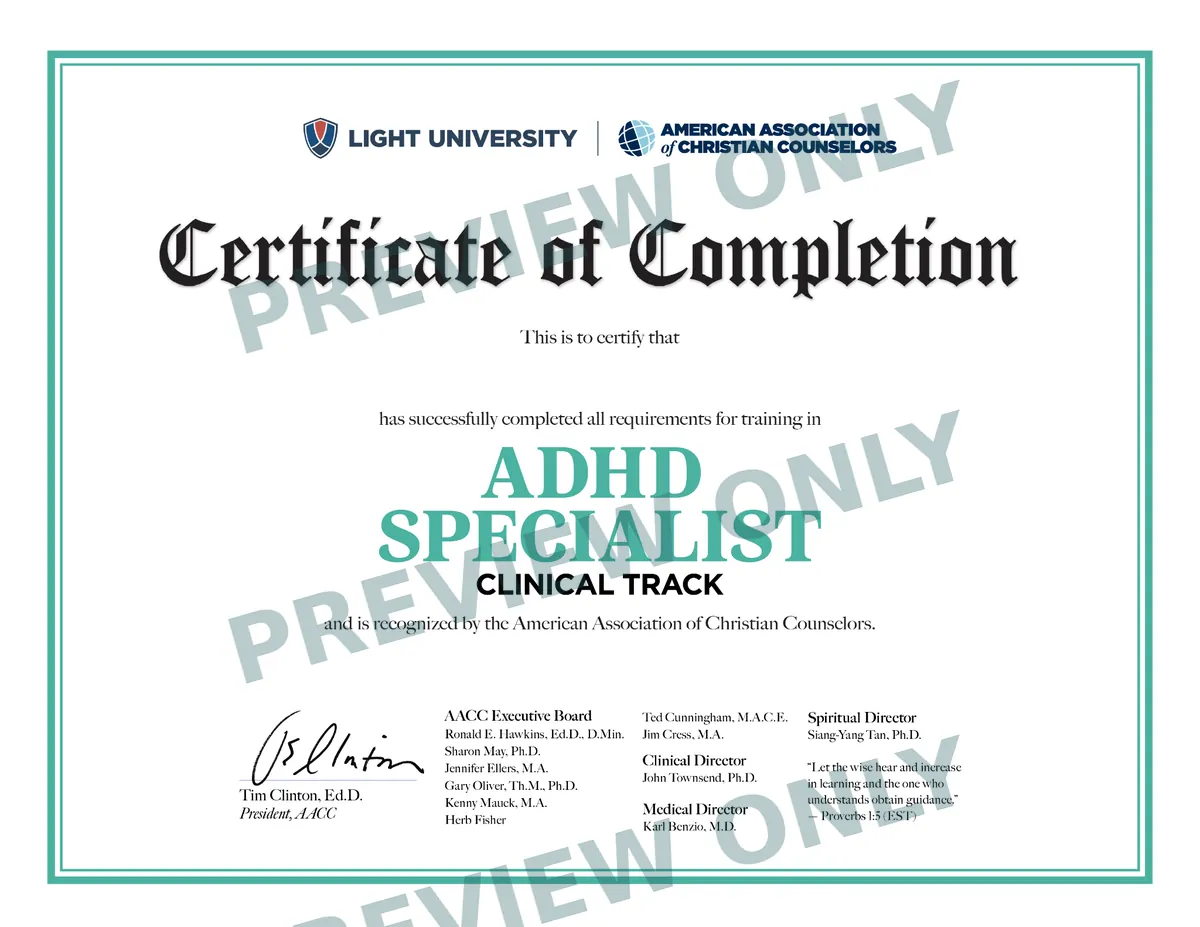
Earn Your ADHD Specialist Certificate of Completion
Complete your chosen training path to earn an ADHD Specialist Certificate of Completion and a training badge you can showcase on your website, professional profiles, and résumé.
Type your name to preview your certificate
 YOUR NAME
This is a personalized preview. Your official certificate of completion and training badge are awarded after you successfully complete your selected path.
Explore the Curriculum
10
Lessons per path
60 min
Per lesson
Notes & transcripts
for every lesson
Competency quizzes
after each lesson
Clinical Track
10 hours · NBCC credit
Included with each Lesson:
ADHD-T 101. Foundations of ADHD: Understanding Attention, Behavior, and Core Characteristics
Instructor: E. John Kuhnley, M.D.
Understand ADHD as a neurodevelopmental condition that affects attention, self-regulation, motivation, and behavior. Explore how these characteristics present in clinical assessment and treatment planning, including the difference between capacity and consistent performance.
ADHD-T 102. Neuroscience of ADHD: Executive Function, Attention, and Self-Regulation
Instructor: E. John Kuhnley, M.D.
Examine the neuroscience of executive functioning, attention regulation, motivation, and emotional control. Connect these systems with clinical formulation and evidence-informed interventions for clients experiencing ADHD-related impairment.
ADHD-T 103. ADHD Across the Lifespan: Children, Adolescents, and Adults
Instructor: E. John Kuhnley, M.D.
Explore how ADHD presents in children, adolescents, and adults. Consider changing developmental expectations, relationships, functional impairment, and age-appropriate approaches to assessment and clinical care.
ADHD-T 104. Diagnosis and Treatment of ADHD
Instructors: E. John Kuhnley, M.D., Gary Sibcy, Ph.D., Mercy Connors, Ph.D., and Zach Clinton, Ph.D.
Study diagnosis and treatment of ADHD as part of evidence-informed clinical practice.
ADHD-T 105. Attention, Motivation, and Behavioral Change in ADHD: Skills, Techniques, and Strategies
Instructor: Gary Sibcy, Ph.D.
Examine challenges with attention, task initiation, motivation, and behavioral change. Explore evidence-informed strategies, structured interventions, and practical techniques clinicians can adapt to client needs and treatment goals.
ADHD-T 106. Emotional Regulation, Stress, and Coping Skill Building
Instructor: Gary Sibcy, Ph.D.
Examine the relationship between ADHD, stress, emotional dysregulation, and coping patterns. Consider clinical strategies for emotional awareness, cognitive flexibility, coping skills, and managing maladaptive responses.
ADHD-T 107. Understanding ADHD Medications for Collaboration with Medical Practitioners
Instructor: E. John Kuhnley, M.D.
Review common ADHD medication approaches, clinical considerations, and the importance of coordinated treatment. Learn how counselors can collaborate appropriately with prescribers while working within their professional scope.
ADHD-T 108. ADHD and Women
Instructors: E. John Kuhnley, M.D., Anita Knight Kuhnley, Ph.D., and Mercy Connors, Ph.D.
Explore how ADHD may be recognized and experienced in girls and women, including masking, emotional regulation, developmental transitions, and overlapping mental health concerns. Consider implications for assessment and individualized treatment.
ADHD-T 109. ADHD and Co-Occurring Mental Health Conditions
Instructor: E. John Kuhnley, M.D.
Examine the relationship between ADHD and commonly co-occurring mental health conditions. Consider differential diagnosis, overlapping symptoms, clinical assessment, treatment planning, and appropriate interdisciplinary collaboration.
ADHD-T 110. Ethical, Cultural, Gender Sensitive, and Professional Standards in ADHD Treatment
Instructors: E. John Kuhnley, M.D., Gary Sibcy, Ph.D., Mercy Connors, Ph.D., and Zach Clinton, Ph.D.
Examine ethical, cultural, gender-sensitive, and professional standards in ADHD treatment.
Coaching Track
10 hours · IBCC credit
Included with each Lesson:
ADHD-C 101. Foundations of ADHD: Understanding Attention, Behavior, and Core Characteristics
Instructor: E. John Kuhnley, M.D.
Understand ADHD as a neurodevelopmental condition affecting attention, self-regulation, motivation, and behavior. Explore lived experience, strengths, and the difference between capacity and consistent performance, then connect those insights with supportive coaching conversations.
ADHD-C 102. Neuroscience of ADHD: Executive Function, Attention, and Self-Regulation
Instructor: E. John Kuhnley, M.D.
Explore the neuroscience of executive functioning, attention regulation, motivation, and emotional control. Apply that understanding to coaching strategies that support planning, task initiation, accountability, and everyday functioning.
ADHD-C 103. ADHD Across the Lifespan: Children, Adolescents, and Adults
Instructor: E. John Kuhnley, M.D.
Explore how ADHD presents in children, adolescents, and adults. Consider developmental demands, relationships, routines, and age-appropriate coaching supports while recognizing when clinical assessment or referral is needed.
ADHD-C 104. Strengths-Based Coaching for Identity and Neurodiversity
Instructor: Jason VanRuler, M.A.
Learn to recognize the difference between capacity and consistent access to ability. Explore how beliefs, shame, identity, and environmental conditions affect functioning. Introduce Jason VanRuler’s ALIGN coaching framework for identifying strengths, reducing barriers, and supporting meaningful change.
ADHD-C 105. Attention, Motivation, and Behavioral Change in ADHD: Skills, Techniques, and Strategies
Instructor: Gary Sibcy, Ph.D.
Examine how attention, motivation, task initiation, and behavioral change are affected by ADHD. Practice strengths-based coaching approaches using external structure, values-driven goals, manageable steps, and supportive accountability.
ADHD-C 106. Emotional Regulation, Stress, and Coping Skill Building
Instructor: Gary Sibcy, Ph.D.
Explore ADHD-related stress, emotional reactivity, and coping patterns. Learn coaching strategies for emotional awareness, flexible thinking, stress management, and everyday coping, with attention to professional boundaries.
ADHD-C 107. Understanding ADHD Medications for Collaboration with Medical Practitioners
Instructor: E. John Kuhnley, M.D.
Review common ADHD medication approaches and why some clients work with medical providers. Understand how coaches can support routines, communication, and follow-through without offering medication advice or stepping outside their scope.
ADHD-C 108. ADHD and Women
Instructors: Anita Knight Kuhnley, Ph.D., E. John Kuhnley, M.D., and Mercy Connors, Ph.D.
Explore how ADHD may be recognized and experienced in girls and women, including masking, emotional demands, and developmental transitions. Consider strengths-based coaching support, accommodations, and appropriate collaboration or referral.
ADHD-C 109. ADHD and Co-Occurring Mental Health Conditions
Instructor: E. John Kuhnley, M.D.
Understand mental health concerns that frequently occur alongside ADHD and how overlapping symptoms can affect daily functioning. Focus on supportive coaching, recognizing red flags, respecting scope of practice, and referring to qualified clinicians when appropriate.
ADHD-T 110. Common Pitfalls and Practical Ethics
Instructors: Jason VanRuler, M.A., and Justin Tilghman, Ph.D.
Explore common coaching mistakes, professional boundaries, client-centered communication, confidentiality, faith integration, accountability, and practical ethical decision-making.
Learn from Experienced Instructors
The program brings together teaching on neuroscience, emotional regulation, clinical care, and coaching. See the curriculum for each instructor’s contribution and the perspectives represented in your track.

E. John Kuhnley, M.D.
Board-Certified Child & Adolescent Psychiatrist · Adult Psychiatry

Gary Sibcy, Ph.D.
Licensed Clinical Psychologist · Professor of Clinical Psychology

Jason VanRuler, M.A.
Licensed Therapist · Author & Coach

Justin Tilghman, Ph.D.
Board-Certified Master Life Coach · Christian Leadership Coach

Anita Knight Kuhnley, Ph.D.
Licensed Professional Counselor · Counselor Educator & Author

Mercy Connors, Ph.D.
Licensed Professional Counselor & Supervisor · Christian Counseling Ethics Specialist

Zach Clinton, Ph.D.
Licensed Professional Counselor · AACC Executive Vice President


“People living with ADHD are often carrying more than the challenges we can see. Many have spent years being misunderstood, questioning their abilities, or feeling they have disappointed the people they love. As Christian counselors and coaches, we have an opportunity to respond with informed care that honors their dignity and takes their struggles seriously. This training brings together a deeper understanding of ADHD and practical approaches to support, helping us serve with greater wisdom and Christ-centered compassion”
Dr. Tim Clinton
President, AACC
Which Training Path Is Right for You?
Clinical Track
For Counselors & Clinical Professionals
Designed to help therapists and clinical professionals recognize the complexities of ADHD, strengthen case formulation and treatment planning, and make more informed decisions about individualized care.
Focus: Clinical assessment, treatment, and professional standards.
Coaching Track
For Coaches & Sub-Clinical Care
Designed to help Christian life coaches, mental health coaches, and ministry leaders turn an informed understanding of ADHD into focused conversations, practical strategies, and support for meaningful goals.
Focus: Strengths-based coaching, everyday strategies, and appropriate referrals.
Choose Your Track & Enroll
Select the specialized 10-hour path that fits your work and gain practical ADHD training you can bring into counseling or coaching sessions. Both paths include continuing education credit and a certificate of completion, and each is currently $99 (regularly $299).
Clinical Track
Strengthen your understanding of ADHD presentations, co-occurring concerns, and treatment approaches so you can make better-informed assessment and care decisions.
Regularly $299
$99
now · including all fees
10 hours of training · NBCC credit
Coaching Track
Learn strengths-based coaching strategies for executive functioning, emotional regulation, routines, and achievable goals so you can offer more focused support.
Regularly $299
$99
now · including all fees
10 hours of training · IBCC credit
Continuing education information
Clinical Track: 10 credit hours; NBCC credit. American Association of Christian Counselors has been approved by NBCC as an Approved Continuing Education Provider, ACEP No. 7543. Programs that do not qualify for NBCC credit are clearly identified. American Association of Christian Counselors is solely responsible for all aspects of the programs.
Coaching Track: 10 credit hours; IBCC credit. The American Association of Christian Counselors (AACC) is an Approved Continuing Education CE provider by the International Board of Christian Care (IBCC). American Association of Christian Counselors is solely responsible for all aspects of the programs.
Participants are responsible for checking the continuing education requirements of their state, licensing board, or professional organization. Review Light University’s continuing education statements.
Frequently Asked Questions
What is included with each lesson?
Each lesson is 60 minutes and includes course notes and a transcript, followed by a competency quiz. Each training path includes 10 lessons totaling 10 hours.
What is the ADHD Specialist Certificate Program?
One certificate program with two specialized training paths exploring how ADHD affects attention, behavior, emotional regulation, relationships, and daily functioning. Each track includes 10 hours of training and is currently $99 (regularly $299), including all fees.
Which track should I choose?
The Clinical Track is designed for therapists and other clinical professionals and includes diagnosis, treatment, and professional standards. The Coaching Track is designed for coaches and those providing sub-clinical care and includes strengths-based coaching, identity, practical skills, and coaching ethics.
Do either of the ADHD Specialist tracks lead to professional certification?
No. Both the Clinical and Coaching Tracks are 10-hour continuing education courses designed to build on participants’ existing professional education, training, and experience.
Upon successful completion, participants receive an ADHD Specialist Certificate of Completion and digital badge.
The Certificate of Completion recognizes that the participant has successfully completed an online training course in ADHD. Neither track awards a professional certification, board credential, or licensure. The certificate does not independently establish professional qualifications or competency to provide ADHD-related services, which depend on the participant’s existing education, training, and experience.
Do I need to be a licensed mental health professional?
The Coaching Track is intended for coaches and those providing sub-clinical care. The Clinical Track is designed for therapists and clinical professionals.
Does the training change my professional qualifications?
No. Neither track grants a professional license or authority to practice outside your existing qualifications. Coaches do not gain authority to diagnose ADHD, provide psychotherapy, or prescribe medication.
Is the training online?
The program is delivered online through Light University with expert-led video lessons and supporting educational materials.
How long is each training path?
Each training path includes 10 lessons totaling 10 hours of training.
Will I receive a certificate?
Yes. Upon successful completion of your chosen training path, you earn an ADHD Specialist Certificate of Completion and a training badge to share on your website, professional profiles, or résumé. This records completed training; it is not a professional license.
What continuing education credit is available?
The Clinical Track offers NBCC credit and the Coaching Track offers IBCC credit, with 10 credit hours per track. Review the approval statements above and check acceptance with your licensing board or professional organization.
What does the current $99 price include?
Each training path is regularly $299 and currently costs $99, including all fees. Enrollment covers one selected 10-hour track; the two tracks are not bundled together.
How is the Coaching Track different from general coaching education?
The Coaching Track is designed for individuals who already have foundational knowledge of the coaching process and experience working with clients. It is not an introductory coaching course and does not provide comprehensive training in foundational coaching competencies or how to establish a coaching practice.
Instead, the program builds on existing coaching knowledge by exploring how ADHD affects executive functioning, attention, motivation, emotional regulation, and identity. Participants learn strengths-based coaching strategies to address challenges involving organization, follow-through, routines, relationships, and personal goals.
The training also emphasizes professional boundaries, recognizing when a client may need clinical evaluation or treatment, and collaborating appropriately with mental health professionals. The goal is to help coaches strengthen their ability to support clients experiencing ADHD-related challenges while working within their existing professional competencies.
Become better equipped to care for people living with ADHD.
When you understand how ADHD affects attention, emotions, relationships, and everyday life, you are better prepared to respond with confidence and practical support. This specialized training connects that understanding to strategies you can apply in counseling or coaching, helping you provide more individualized care to the people who rely on you. Choose the training path that fits your work and strengthen the skills you bring to each session.
Light University · American Association of Christian Counselors
