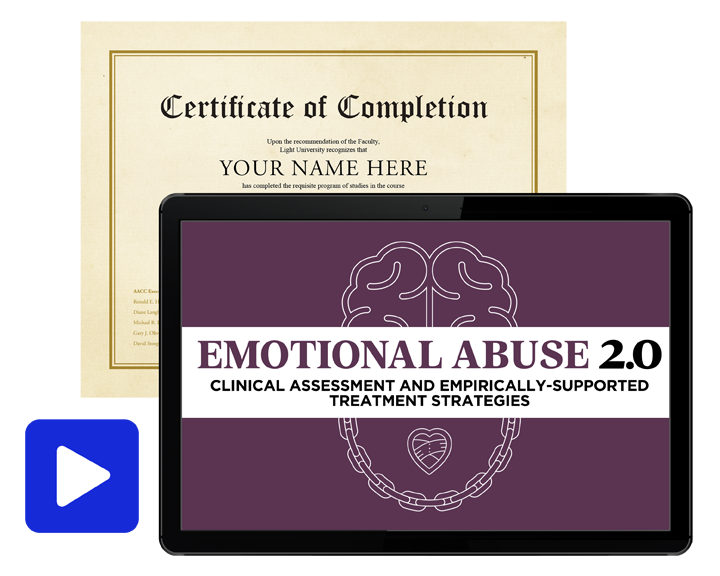
Emotional Abuse 2.0
$69.00
-
3 credit hours
Continuing Education Accreditations applicable to this course
NBCC, IBCC, Florida Board of Clinical Social Work, Marriage and Family Therapy and Mental Health Counseling
Intended Audience: Mental and Medical Health Professionals, Mental Health Coaches
Emotional Abuse 2.0
Presenter
Amy S. Feigel, M.A., LPC
Summary
Emotional abuse is an often under-recognized form of psychological trauma that can have profound and lasting effects on mental health. Emotional abuse has been described by many as the “invisible wound” that destroys one's self-concept, interpersonal functioning, and overall well-being. This video-based, clinical training program is designed for anyone working in the field of mental health and people-helping professions seeking to strengthen their assessment and treatment skills when working with individuals who have experienced emotional abuse. Participants will learn about and explore the dynamics and patterns of emotional abuse including concepts such as coercive control, manipulation, gaslighting, chronic criticism, humiliation, and emotional neglect. This workshop will also review the psychological, cognitive, emotional, and neurobiological impacts of emotional abuse on the survivor along with discussing common co-occurring mental health disorders such as anxiety, depression, complex trauma / PTSD, low self-esteem, and attachment difficulties. Evidence-based assessment strategies and trauma-response interventions will be presented to support accurate case conceptualization and effective treatment planning. Through actual case study presentation, participants will develop skills to recognize emotional abuse, validate client experiences, and help foster safety and empowerment of the survivor. For willing Christian clients, scriptural insights and faith-based interventions will also be included to assist survivors in achieving transformational healing and recovery after the abuse they have endured. Upon completion of this course, participants will confidently know how to help survivors achieve a secure interpersonal identity that will have a profound impact on all relationships moving forward.
Learning Objectives
Participants will...
- Identify and describe the core characteristics, dynamics, and behavioral patterns of emotional abuse.
- Assess and conceptualize the psychological, emotional, and relational impacts of emotional abuse by utilizing trauma-informed assessment and case formulation strategies.
- Apply evidence-based interventions and techniques to support client safety, emotional regulation, empowerment, resilience, and healthy relationship functioning with specific insights and techniques for willing Christian clients.
Lesson Titles
EAB 101: Clinical Conceptualization and Assessment of Emotional Abuse: The Invisible Wound
Amy S. Feigel, M.A., LPC
EAB 102: Diagnosis, The Brain/Body Connection, and Attachment
Amy S. Feigel, M.A., LPC
EAB 103: Evidence-based Treatment Strategies for Empowerment and Resilience: God, Self, and Others
Amy S. Feigel, M.A., LPC
References
Abusbaitan, Hanan A., Eyadat, Anwar M., Holt, Jeana M., Telfah, Reem K., Zahra, Tala F. Abu, Zahra, Tuleen F. Abu, Mobarki, Amani A., Mkandawire-Valhmu, Lucy, Kako, Peninnah M., Gondwe, Kaboni W., Lopez, Alexa A., Emotional Abuse Against Women in the Context of Intimate Relationships: A Concept Analysis, Nursing Forum, 2025, 6301140, 17 pages, 2025. https://doi.org/10.1155/nuf/6301140
Jung, J., I. Baek, and J. Han. 2026. “Childhood Emotional Abuse and Adult Mental Health: Does Whom You Interact With Matter?.” Child Abuse Review35, no. 1: e70093. https://doi.org/10.1002/car.70093
Kassing, K, & Collins, A. “Slowly, Over Time, You Completely Lose Yourself”: Conceptualizing Coercive Control Trauma in Intimate Partner Relationships. Journal of Interpersonal Violence. Volume 41, Issue 3-4, February 2026, Pages 662-684 https://doi.org/10.1177/08862605251320998
Salcioglu, E., Cankardas, S. Psychological violence in intimate relationships: stressor interactions and psychological outcomes. Curr Psychol 45, 226 (2026). https://doi.org/10.1007/s12144-025-08676-0
Tanriverdi, A.E., Iverson, G.L. & Valera, E.M. Examining Associations Between Intimate Partner Violence-Related Brain Injury, Psychological Abuse, and Cognitive Functioning in Community Women. J Fam Viol (2026). https://doi.org/10.1007/s10896-025-01032-7
Turhan, C., & Eryılmaz, A. (2026). Understanding Emotional Neglect and Emotional Abuse: A Holistic View from Conceptualization to Intervention. Psikiyatride Güncel Yaklaşımlar, 18(1), 30-53. https://doi.org/10.18863/pgy.1602868
Website: Women’s Law.org https://www.womenslaw.org/about-abuse/forms-abuse/emotional-and-psychological-abuse-0
Continuing Education Statement
 American Association of Christian Counselors has been approved by NBCC as an Approved Continuing Education Provider, ACEP No. 7543. Programs that do not qualify for NBCC credit are clearly identified. American Association of Christian Counselors is solely responsible for all aspects of the programs.
 The American Association of Christian Counselors (AACC) is an Approved Continuing Education CE provider by the International Board of Christian Care (IBCC). American Association of Christian Counselors is solely responsible for all aspects of the programs.
The American Association of Christian Counselors (AACC) offers some psychologists, therapists, counselors, social workers and play therapists Continuing Education (CE) credit due for good standing with certain states and a limited number of professional organizations. It remains the responsibility of each participant to be aware of state licensure and CE requirements.
Participants should check their state and/or local regulations regarding required continuing education hours. For more information Light University Continuing Education programs, please visit: https://lightuniversity.com/continuing-education-statements/